
Cougar History and Ecology Part 1
The Cougar Fund shared this 12 part series as a primer on social media to provide background information about the cougar, its needs, its place in history, how humans have vilified then studied, then discovered its worth, targeted as a source for recreation and then vilified again. How does the cougar’s adapt to changing landscapes, unstable human perspectives and the fact that all environmental decisions ultimately end up with politicians?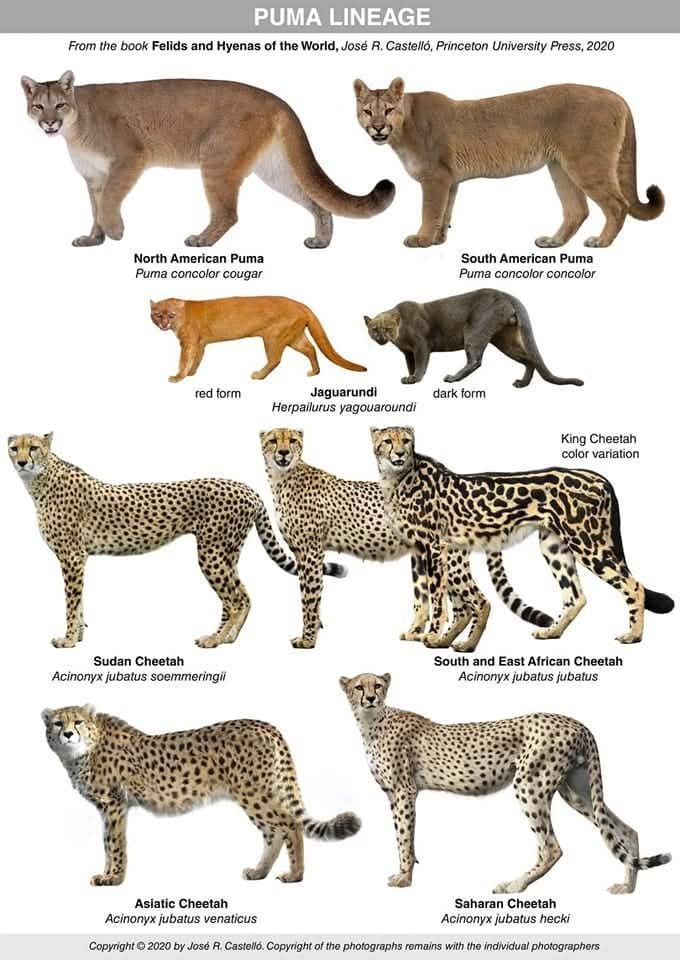
Cougar History and Ecology | Part 1
Mountain lions belong to an ancient branch of the cat family, one that split from other cats millions of years ago. Their closest living relatives may surprise you: the cheetah and the jaguarundi. Though they look and live very differently today, they share a deep evolutionary ancestry shaped by time and survival. Over millions of years, mountain lions evolved alongside many cat species that no longer exist. While we cannot sample DNA from those extinct relatives, their presence shaped the pressures and landscapes that forged the puma we know today. The mountain lion is not a relic. It is a survivor. Cougars are remarkably adaptable. They can live at low densities, but over wide ranges, are able to navigate rugged terrain, and adjust to a wide variety of prey and habitats. This flexibility is why they survived dramatic climate shifts and extinctions that eliminated many large carnivores.This post begins a series exploring cougar ecology, behavior, and the science behind their role in healthy ecosystems.
To find out more about their historical timeline, visit: https://cougarfund.org/about-the-cougar/historical-timeline/
Image from the book: “Felids and Hyenas of the World” by José R. Castelló, Princeton University Press, 2000
The Cougar Fund – Protecting America’s Greatest Cat
cougarfund.org
The Cougar Fund – Protecting America’s Greatest Cat
Protecting the cougar – also known as a mountain lion, puma, and panther – and other carnivores throughout the Americas since 2001.